Saturday, January 28, 2012

2012 January - October Events at Seligmann Center


September 2012- March 2013 

Kurt Seligmann at Home 
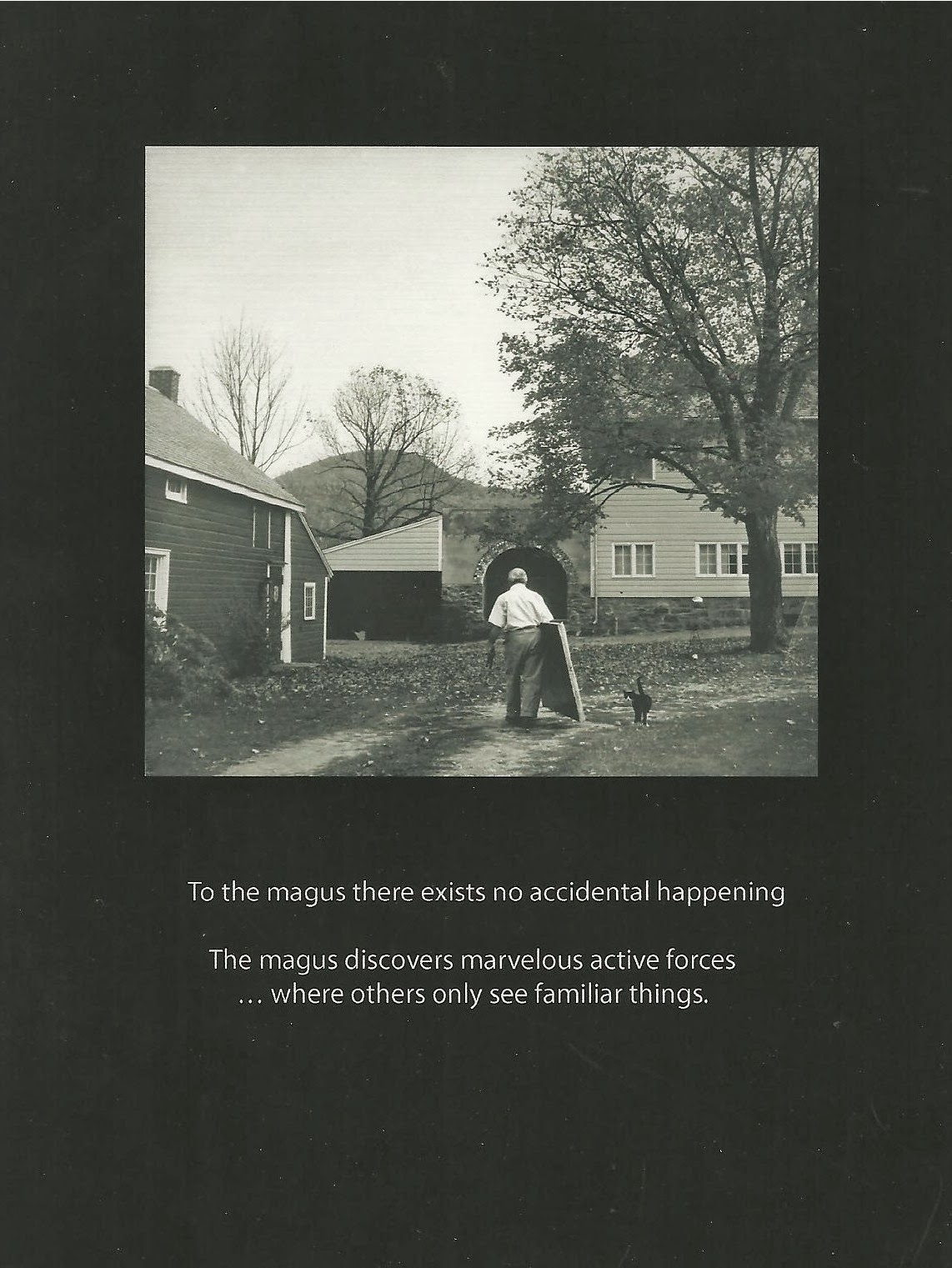
                                        
an exhibit of personal photos, letters, original art work and household items of Surrealist Kurt Seligmann (1900-1962). The exhibit is intended to provide a more personal view of one of the key figures in Surrealism. It is based on the few hundred snapshots, photos, letters and original art works in the collection. Many of these are reproduced on canvas panels hung throughout Seligmann's studio. 

David Horton, artist and Professor of Art at William Paterson University, curated, designed and produced the exhibit with help from Madeline Gersack, Dorothy Szefc, Janet Hamill, Bill Seaton, Daniel Mack, Nancy Proyect, Bonnie Neucall, Nick Zungoli and Lucinda Poindexter.

On the Grounds
Book-Tree: from a series by Jed Bark
Spirals: the first public presentation of the work of  Julius Medwin:


September 29, 2012
Workshop by Janet Hamill.   
Hamill will discuss the work of John Ashbery, Barbara Guest, Kenneth Koch, Frank O’Hara and James Schuyler, all of whom were greatly influenced by Surrealism’s liberating effects on poetry and the visual arts.   All five poets lived in New York City in the early 1950’s when Abstract Expressionism (a movement influenced by Surrealist painters) was riding its heroic crest.  In their work they were attempting to simulate in language what Pollock, De Kooning and Kline were doing with paint.  All five knew each knew each other socially and either worked in NY art museums or wrote for art publications.  Theirs was a poetry as fresh and original as the painters they admired and reflected their reactions to classic modernists, such as Pound and Eliot and their contemporary rivals of the Confessional school.  In addition to a discussion and examination of the first generation of New York School poets, participants will have the opportunity to write a poem in the style of one of the poets.  Following the presentation/workshop, there will be a reading of poems by the New York School poets by area poets Adrianna Delgado, Michael Sean Collins, Florence Lenhard, Marina Mati and Glenn Werner.   Janet Hamill, producer:   NYC poet attended readings by Ashbery, Guest, Koch and Second Generation NY School poets, is the author of five books of poetry and short fiction.  Her work has been nominated for the William Carlos William Prize and a Pushcart Prize. 


August 22, 2012
Fantasy Drawings of Chaim Gross installed by Jonathan and Marsha Talbot

May 31, 2012
Talk by surrealist expert Stephen Robeson Miller

June 8, 2012 
Films of George Kuchar, Felix Bernstein, guest


May 25, 2012
Second Surrealist Cabaret


April 27, 2012 at 7:30pm
Three films by Filmmaker Jacob Burckhardt

A Guided Tour of Edith's Apartment video by Jacob Burckhardt, 2010, 47 minutes
In March 2009, Edith Schloss Burckhardt, the 90-year-old painter and writer, took her son, the filmmaker Jacob Burckhardt, on a tour of her apartment. Edith has been living in the historic center of Rome since 1962, painting and writing art criticism and her memoirs.

Yaknetuma from the Lower East   1974, 9 min., color Jacob Burckhardt in collaboration with Laleen Jayamanne, is dance filmed on the streets and rooftops of New York, based on an ancient Sri Lankan exorcism ritual.

Roma    2004, 11 minutes, 16mm, Black and White
A poetic view of the Modern Ancient city from the point of view of a familiar pedestrian. Stones, water, graffitti, lights, the Pope, cats, people in the streets, clouds, markets, and even a few monuments, captured on a Bolex with grainy black and white film. Camera, editing, and sound by Jacob Burckhardt, music by Carlo Buti and Tschipolla

ABOUT JACOB BURCKHARDT
Jacob Burckhardt has been directing and producing films since the early nineteen seventies. All the while making underground movies, Jacob Burckhardt has worked at a variety of jobs: blueberry picker, steel Mill laborer, Fuller Brush man, truck driver, taxi driver, camera repairman and photographer of painting and sculpture. He has done sound recording in North Africa, worked in the industry as staff re-recording mixer at Ross-Gaffney, Inc., and now runs a post-production sound editing and mixing facility at Workedit, Inc.

He has made 33 movies, most in 16mm and some in video and super-8. In 2002, he began a collaboration with Royston Scott which has resulted in three movies in the series "Black Moments in Great History," the latest of which is "Tomorrow Always Comes." His 16 millimeter work also includes a series of poetic and contemplative black and white shorts, such as "Roma" (2004), a "poetic" view of the modern ancient city from the point of view of a familiar pedestrian, with stones, water, graffiti, lights, cats, pedestrians, and even the Pope.
Eschewing the money raising rat race, he now prefers shorts in film and video, where it is possible to preserve a direct relationship between the film and the film makers, and still photography on gelatin silver paper.
Jacob Burckhardt is son of the Swiss-born photographer and experimental filmmaker Rudy Burckhardt.

March 27, 2012
Film Festival. Fat Feet. Mimi Gross as guest.    Robert Whitman, Julie Martin producers


March 9, 2012
  all posters by David Horton

William Seaton presented a program of his translations from German Dada poets as well as a general account of the Dada movement  “A Word that Means Nothing,” refers to Dadaist Tristan Tzara’s comment that Dada means nothing. (Embracing contradiction, Tzara also said Dada was “a roaring of tense colors, and interlacing of opposites and of all contradictions, grotesques, inconsistencies.”)

According to Seaton, “The Dadaists established all the major trends of experimentation that have prevailed for the last hundred years. Their work is the most significant source from which Surrealism emerged. No one has established an artistic position more radical than theirs.” Seaton’s Dada Poems from the German with an introduction by Timothy Shipe, curator of the University of Iowa’s Dada Archive, has just been published by Nirala Publications. His translations of German Dadaist poetry have earlier appeared in Adirondack Review, Read and Destroy. Mad Blood, Maintenant, and Chelsea.

Seaton has been translating poetry since his versions of Sappho were published in Oblique when he was an undergraduate at the University of Illinois in 1967. He later studied literary translation under Anselm Hollo and Stavros Deligiorgis at the University of Iowa’s Translation Workshop. He directs the Poetry on the Loose Reading/Performance Series, teaches at the College of Poetry (www.collegeofpoetry.com), and posts five essays, literary and familiar, on the first of every month at williamseaton.blogspot.com.

This event is part of a Surrealism Festival paying homage to Kurt Seligmann, an émigré artist who made his Sugar Loaf home a center for Surrealism in America. Under the auspices of the Orange County Citizens Foundation, the Festival includes performance events, exhibits, films, and workshops. For details, call 845-469-9459

March 27, 2012
Homage to Kurt Seligmann. An international collage exhibit  curated by Jonathan Talbot and Jessica Lawrence till June 15


February
Surrealist Garden started in bog on property, Jerome Spector

February 24, 2012
"THE LAST CLEAN SHIRT"
About 60 people came to this film, discussion and poetry reading of Frank O'Hara poems by Michael Sean Collins, Adrianna Delgado, Janet Hamill, Florence Lenhard, Marina Mati, Glenn Werner & Christopher Wheeling.
Here's the Frank O'Hara poem Janet Hamill read:

Lines For The Fortune Cookies

I think you're wonderful and so does everyone else.
Just as Jackie Kennedy has a baby boy, so will you--even bigger.
You will meet a tall beautiful blonde stranger, and you will not say hello.
You will take a long trip and you will be very happy, though alone.
You will marry the first person who tells you your eyes are like scrambled eggs.
In the beginning there was YOU--there will always be YOU, I guess.
You will write a great play and it will run for three performances.
Please phone The Village Voice immediately: they want to interview you.
Roger L. Stevens and Kermit Bloomgarden have their eyes on you.
Relax a little; one of your most celebrated nervous tics will be your undoing.
Your first volume of poetry will be published as soon as you finish it.
You may be a hit uptown, but downtown you're legendary!
Your walk has a musical quality which will bring you fame and fortune.
You will eat cake.
Who do you think you are, anyway? Jo Van Fleet?
You think your life is like Pirandello, but it's really like O'Neill.
A few dance lessons with James Waring and who knows? Maybe something will happen.
That's not a run in your stocking, it's a hand on your leg.
I realize you've lived in France, but that doesn't mean you know EVERYTHING!
You should wear white more often--it becomes you.
The next person to speak to you will have a very intriquing proposal to make.
A lot of people in this room wish they were you.
Have you been to Mike Goldberg's show? Al Leslie's? Lee Krasner's?
At times, your disinterestedness may seem insincere, to strangers.
Now that the election's over, what are you going to do with yourself?
You are a prisoner in a croissant factory and you love it.
You eat meat. Why do you eat meat?
Beyond the horizon there is a vale of gloom.
You too could be Premier of France, if only ... if only... Frank O'Hara

January 27, 2012     A truly charmed event:
7:30 to 10pm     Film Festival Started... 100+ people attend:
  • an introduction and invitation to the Seligmann Center for Surrealism
  • an introduction to Pull My Daisy and David Amram
  • David Amram's comments on the film
  • the Film, Pull MyDaisy
  • readings of five Kerouac poems by Joe Aniska, Michael Sean Collins, Janet Hamill & Frank Messina with keyboard by David Amram
  • visiting and q&a with David Amram

Januray 2, 2012
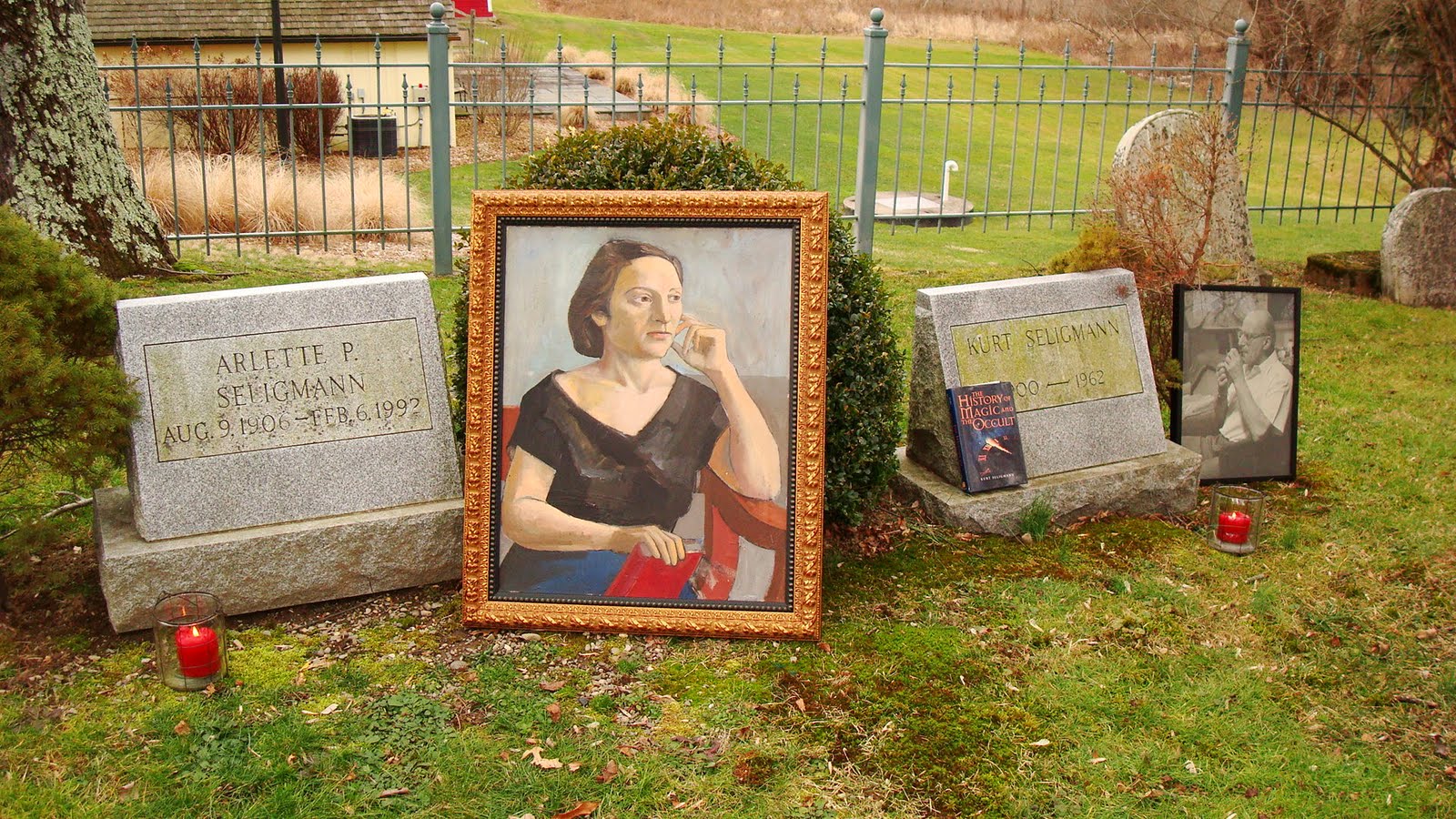
This was the 50th year since Kurt Seligmann's death. His wife, Arlette, died 20 years ago this  February.
A few of us gathered at his Homestead and gravestone, dressed in ways to honor his work: his history of magic and occult, his many danse macabre figures. We gathered and spoke about how important he was in helping Jewish artists escape Europe in the late 1930s, his own work at realising figures from our shadow lives, his hosting of major figures in 20th century art here in Sugar Loaf, NY and how we are grateful for the gift of this beautiful land to "the Citizens of Orange County"
Jonathan Talbot made and shared this video.


Seligmann website

Saturday, January 21, 2012

QUOTES from Seligmann: artist as alchemist and more


In "Magic Circles," for View, Seligmann used Jung as the springboard for an analogy between artistic creation and alchemical process:

According to Jung, the alchemic process is mainly of a psychic nature; and this makes it even more analogous to the artist's labor. In vain do we seek to investigate the nature of the occult forces which are at work in the act of artistic creation. The artist himself does not master them. He is subjected to them just as a medium experiences the trance; and it is in this state that the artist produces beings which obey the morphological laws and the ordering forces of nature.

From Martica Sawin

Another

In The History of Magic and the Occult Kurt Seligmann writes:
We think of the magus as the possessor of occult secrets, a master of esoteric wisdom, who makes use of this knowledge for his own good as well as for that of his fellow men. He is a “white” magician, less fond of prodigies than of the contemplation of nature, in which he discovers marvelous active forces where others only see familiar things. For him the power of God is not concentrated in this One, but permeates every being of the universe. (Seligmann 206)

MORE Writing from Seligmann

Kurt Seligmann’s “Heritage of the Accursed” from Charles Henri Ford‘s magazine View (number 5, December 1945). Reprinted in View: Parade of the Avant-Garde 1940–1947 (compiled by Catrina Neiman & Paul Nathan; printed by the Thunder’s Mouth Press in 1992) as pages 179–182.

Seligmann Website

Thursday, January 12, 2012

Surrealism: the Occult, Alchemy, War


I've just read and enjoyed Nadia Choucha's Surrealism & the Occult (1991).  I'll be adding more notes. Here's a starter (and a few Max Ernst works):

Nadia Choucha’s general summary of basic occult principles:

The universe is a single living substance.
The universe is comprised of interactive opposites.
Mind and matter are a unified entity.
Everything that exists corresponds in universal analogy –man/ woman is a microcosm of the universe.
Imagination is a real motivating force that can act upon matter in a subtle way.


Someone asked yesterday if I thought there was a resurgence of surrealism in Orange County??
Actually, I don’t think there’s a resurgence of Surrealism. There’s a resurgence of INTEREST in Surrealism. The February 2012 show, The Graffiti of War, in Montgomery at Mikey Teutul's Wolf Gang Galley may be a start. There are a lot-- a lot of veterans in Orange County. Art is a way for some of them to convey what happened.
Surrealism was a response to war. We are now in our 11th year of war. What’s taking surrealism so long to show back up?
Surrealism is just a name given to a literary, then visual response to the shocking poverty of a military or capitalist approach to strife. The Surrealists were passionate about urging some encounter with the unconscious as a component in a balanced life.
Hmmm... Is surrealism just another form of PTSD... if so, hold on there's more to come!

Monday, December 5, 2011

What Surrealists did ... TECHNIQUES

WHAT IS IT??
Surrealism is the magical surprise of finding a lion in the closet when you were sure of finding shirts.

- Frida
Kahlo


HOW DO YOU DO IT?

SURREALISM TECHNIQUES to better access the unconscious: techniques to alter, challenge, violate everyday perception and understanding

Aerography a 3-dimensional object is used as a stencil with spraypainting.

Bulletism shooting ink at a blank piece of paper. then develop images based on what is seen.

Calligramme a text or poem in which the words or letters make up a shape, particularly a shape connected to the subject of the text or poem. developed by Guillaume Apollinaire

Collage assemblage of different forms creating a new whole. may include newspaper clippings, ribbons, bits of colored or hand-made papers, photographs, etc., glued to a solid support or canvas.

Coulage involuntary sculpture made by pouring a molten material (such as metal, wax, chocolate or white chocolate) into cold water. As the material cools it takes on what appears to be a random (or aleatoric) form, This technique is also used in the divination process known as ceromancy.

Cubomania method of making collages in which a picture or image is cut into squares and the squares are then reassembled without regard for the image. first used by the Romanian surrealist Gherasim Luca.

Cut-up technique text is cut up at random and rearranged to create a new text.

Decalcomania spreading thick paint upon a canvas then—while it is still wet—covering it with further material such as paper or aluminium foil. This covering is then removed (again before the paint dries), and the resultant paint pattern becomes the basis of the finished painting. much employed by Max Ernst.

Eclaboussure oil paints or watercolors are laid down and water or turpentine is splattered, then soaked up to reveal random splatters or dots where the media was removed. This technique gives the appearance of space and atmosphere. in paintings by Remedios Varo.

Entopic graphomania method of drawing in which dots are made at the sites of impurities in a blank sheet of paper, and lines are then made between the dots; these can be either "curved lines... or straight lines.".

Étrécissements cutting away of parts of images to encourage a new image, by means of a pair of scissors or any sharpened instrument. Collage is perceived as an additive method of visual poetry whereas Étrécissements are a reductive method. F Marcel Mariën in the 1950s.

Frappage flowers or leaves are pounded onto canvas or paper to create colors and shapes.

Frottage using a pencil or other drawing tool and makes a "rubbing" over a textured surface. The drawing can either be left as is or used as the basis for further refinement.

Fumage impressions are made by the smoke of a candle or kerosene lamp on a paper or canvas.

Games are important not only as a form of recreation but as a method of investigation. The intention is to cut away the constraints of rationalism and allow concepts to develop more freely and in a more random manner. The aim is to break traditional thought patterns and create a more original outcome.
Exquisite corpse is a method by which a collection of words or images are collectively assembled, the result being known as the exquisite corpse or cadavre exquis in French. Later the game was adapted to drawing and collage.Time Travelers' Potlatch is a game in which two or more players say what gift they would give to another person - this is usually an historical person who played a role in, or had an influence on, the formation of Surrealism.

Grattage paint (usually dry) is scraped off the canvas. employed by Max Ernst and Joan Miró.

Heatage an exposed but unfixed photographic negative is heated from below, causing the emulsion (and the resulting image, when developed) to distort in a random fashion. David Hare

Involuntary sculpture absent-mindedly manipulating something, such as rolling and unrolling a movie ticket, bending a paper clip, etc

Mimeogram automatic art made by peeling off the backing sheets of mimeograph stencils.

Movement of liquid down a vertical surface a technique of making pictures by dripping or allowing a flow of some form of liquid down a vertical surface.

Outagraph the subject, of a photograph is cut out. Ted Joans

Paranoiac-critical method the artist invoking a paranoid state (fear that the self is being manipulated, targeted or controlled by others). The result is a deconstruction of the psychological concept of identity, such that subjectivity becomes the primary aspect of the artwork.Salvador Dalí

Parsemage dust from charcoal or colored chalk is scattered on the surface of water and then skimmed off by passing a stiff paper or cardboard just under the water's surface. Ithell Colquhoun

Photomontage composite picture by cutting and joining a number of photographs.

Soufflage liquid paint is blown to inspire or reveal an image. Jimmy Ernst

Triptography is an automatic photographic technique whereby a roll of film is used three times (either by the same photographer or, in the spirit of Exquisite Corpse, three different photographers), causing it to be triple-exposed so any single photograph having a clear and definite subject is nearly impossible

Tuesday, October 18, 2011

2011 Seligmann Center Event History


December 2, 2011    Surreal Cabaret
performance, experimentation, improvisation, and audience involvement
David J. Glover, Oliver Grech, Jennifer Kraus, David Horton, Daniel Mack, Steve Roe, Patricia Seaton, William Seaton


October 15, 2011
Robert Whitman MoonRain   performance  as a fundraiser for Farm Relief in Orange County. VIDEO


 Columbus Day 2011


Jonathan Talbot has applied considerable time, craft and ingenuity to refurbishing Kurt Seligmann's etching press. This project was fueled by the discovery of two almost indentical plates Seligmann did in 1940 for a limited edition run of Andre Breton's poem Pleine Marge.On Columbus Day 2011, Jonathan and I met at the Seligmann Homestead to actually try the press for the first time since Seligmann's death in 1962. Jonathan was well prepared with ink, applicators, rags, and many tools, gadgets and devices I knew nothing about. I was there as a helper, "the guy with the clean hands". In three hours, we got about ten prints. I was so content just doing what I was told and watching the results pile up under big blotter paper. I've taken Jonathan's renowned Collage Workshop at his studio and know how he can both take charge and allow for appropriate learning.

The first three prints were sold at the Robert Whitman MoonRain . VIDEO


September
Surrealist poetry workshop. Janet Hamill. Funded by Poets and Writers

Summer, 2011   
We discovered Seligmann's original etching press in an outbuilding on the Farm, the Ice House/Guest House, and it looks like it can be restored and used to make prints. We are looking around to see if there are any original plates that Seligmann had made. When the weather allows, we'll start the restoration process  We talked about artists coming to use the press to make prints and for us to do a small edition of a Seligmann-inspired print as a fundraiser.

Thursday, July 7, 2011

Kurt Seligmann's Press


In an old ice house on Kurt Seligmann's farm, we found the parts of his litho press. Stories have it that it was used for his own work as well as work by others: that Alexander Calder did work on it and that a fundraising edition of work was produced on it to help start the magazine View
Jonathan Talbot is doing the repairs and restoration.

Sunday, December 12, 2010

WHO IS KURT SELIGMANN? Basic Bio + images


Kurt Seligmann was born on July 20, 1900 in Basel, Switzerland. In 1920, Seligmann studied at the Ecole des Beaux-Arts in Geneva. He later went on to study at the Academy of Fine Arts in Florence. In 1927, he moved to Paris and began exploring the style, technique, and vision of Surrealism in his art.
Seligmann’s career evolved during the late 1930s and 1940s, when he was a member of the Abstraction Creation Group in Paris. When he moved to New York with his wife Arlette in 1939, he became one of the first members from the Parisian surrealist movement to settle in the area. There he began exhibiting at the Karl Nierendorf Gallery, a space where such artists as Wassily Kandinsky (1866-1944) and Paul Klee (1879-1940) also showed. His move to New York allowed him to become immersed in the Abstract movement taking place in the city. In addition to having regular exhibitions in various New York galleries, Seligmann also taught at Brooklyn College and Briarcliff Junior College. It was during this time that he also designed sets for dance and ballet groups. 


In 1940, Seligmann and his wife moved to a old dairy farm in the small town of Sugar Loaf, New York where, during his career, they had regular social interactions with his fellow surrealist colleagues, such as Alexander Calder (1898-1976), Yves Tanguy (1900-1955), Ossip Zadkine (1890-1967), and art historian and critic Meyer Schapiro (1904-1996). Throughout the 1940s, Seligmann continued to participate in exhibitions in New York, including one in which the proceeds benefited war relief for French children. In addition, Seligmann was interested in magic and the occult. In 1948, he wrote his first and only book on magic, entitled The Mirror of Magic.
Seligmann returned to Europe for vacations, though never for long stints. He and his wife kept a home in Paris that they frequently rented out to European painters. The couple made their final trip to Paris in 1949 to visit family and friends. Upon their return, Seligmann taught at Brooklyn College and gave lectures throughout the East Coast as both an artist and a professor. His style continued to be an inspiration to his fellow artists. Seligmann was long interested in psychoanalysis and implemented ideas of the theory in his work. His portfolio also included aspects of fantasy and the unrealistic. At the same time, it explores the inner psyche and the unconscious as it related to his artwork and surrealist inspirations.
The period between World War I and II was a tumultuous time in which Surrealism flourished. Seligmann’s explorations of the inner psyche are perhaps further commentaries on the general state of mind and disillusionment taking place at the time. At the age of 61, Kurt Seligmann died of an accidental gunshot wound while on his farm in Sugar Loaf. His wife bequeathed part of his estate to the Orange County Citizens Foundation of Sugar Loaf, New York. She dedicated the rest of her life to preserving the memory of her husband.

II. AN ANALYSIS OF THE ARTIST'S WORK

Kurt Seligmann began his career at a difficult time. During the inter-war period, a general feeling of disillusionment amongst society had developed. It was during this time that modernism and surrealism became an outlet for psychological commentary. Kurt Seligmann made his place in the art community of this time by exploring the psyche, and exposing the inner consciousness on canvas. His works consist of dream-like, almost unrealistic figures engaging in battle-like scenes, donning ribbons, armor and weapons. His compositions employ bright and exploding colors, and are an exploration of the irrational and inner cognizance. One is not meant to make much sense of his works, because they are reflections of the unexplainable.
His work, similar to fellow surrealist, Salvador Dali (1904-1989), explored not only the complications within the human mind, but also the instability of the outside world. During Seligmann’s time, this instability was the result of war. This instability manifested itself in his works through the way he manipulated abstract forms to resemble human figures. The reference to the human form is an acknowledgment that the artist has not neglected the reality of the physical realm in his work. By using human figures, along with surreal, fantasy-like figures, Seligmann reconciles the realm of the unconscious with that of the physical.
His imaginary sequences were feasts for the mind, with his bold use of color and enigmatic figures. Stephen Robeson Miller, of the Orange County Citizens Foundation, analyzed Seligmann’s work by saying “a characteristic Seligmann painting depicts a kind of dance macabre in which anthropomorphic figures- comprised of an amalgamation of armour, heraldic devices, ribbons, cloth, helmets, feathers, bone and ceremonial paraphernalia- cavort in unknown rituals in darkly cavernous, yet undetermined, space.” Miller goes on to explain that these characteristic Seligmann paintings are evidence of the psychoanalysis studies going on at the time, as well as the conflicts over war that were taking place. Just like human dreams can be vague and ambiguous, so are Seligmann’s paintings. In fact, he exploits this ambiguity to further his own cause, and express his own goals as an artist. His surreal sequences call for analysis and contemplation, just as the events in Europe at the time did.
Seligmann drew much inspiration from European art of earlier periods. The imaginative, visionary sequences he creates in his surrealistic paintings can be tied to fantasy paintings of the 15th and 16th centuries of Swiss and Bavarian art. In doing so, Seligmann creates a tie between the old world and the new world, adding a historic context to his art. Furthermore, Seligmann used different historic periods and artistic periods as inspiration for his own art. Seligmann took inspiration from artists such as Pablo Picasso (1881-1973), as many of his paintings employ cube-like geometric shapes, and Dali, with his dreamlike sequences. Some of his paintings are also allusions to Greek mythological figures. An example of a painting for which Seligmann used historical inspiration is his painting Leda (oil on canvas), dated 1958. The painting is a surreal depiction of the story of the Greek king of the gods, Zeus, who takes on the physical embodiment of a swan in order to seduce/rape a beautiful woman, Leda. Using muted colors, enigmatic, stringy shapes, and somewhat familiar figures, Seligmann transforms this centuries-old tale into a modern, fantasy-like scene.
From the 1930s, when he began his career as a Surrealist in Paris, until his death in 1962, Kurt Seligmann was a monumental figure within the Surrealist movement especially in America. During a time of psychological exploration, societal disillusionment, and international warfare, Seligmann’s work looked within. Using bold colors, enigmatic shapes and figures, and inspiration from other historical and artistic periods, he painted pictures of the irrational and scenes one can only understand in dreams. As Stephen Robeson Miller suggests, his paintings embody “aspects of his personality, background, and temperament.” Seligmann put himself behind his paintings, and used his background, his state of mind, and his own personality to create distinct works of art.

III. CHRONOLOGY

· 1900 Kurt Seligmann was born in Basel, Switzerland (July 20)
· 1920 Studied at the Ecole des Beaux-Arts, Geneva
· 1927 Studied at the Academy of Fine Arts, Florence
· 1929 Seligmann moved to Paris and joins the Surrealist movement
· 1939 Seligmann moved to New York with his wife, Arlette
· 1939 First exhibited at the Kare Nierendorf Gallery in New York, as well as the Golden Gate Exposition in San Francisco
· 1939-40 Began teaching at Brooklyn College and Briarcliff Junior College
· 1940 Moved to a farm in Sugar Loaf, New York with wife Arlette
· 1941 Participated in the “First Papers of Surrealism” exhibition, for the benefit of French children during WWII
· 1942 Participated in the group show, “Artists in Exile” among fellow surrealists, Pierre Matisse Gallery , NYC
· 1948 Published his first book on the occult, The Mirror of Magic
· 1949 Returned to Europe (Paris) for the last time
· 1950s Seligmann and wife Arlette became naturalized U.S. citizens; Seligmann continued teaching at Brooklyn College, and lecturing throughout New England
· 1962 Kurt Seligmann died of an accidental gunshot wound in Sugar Loaf, NY

IV. COLLECTIONS

· Aubusson, Bibliotheque Nationale, Paris, France
· Albright-Knox Art Gallery, Buffalo, New York
· Art Museum of Sao Paolo, Brazil
· Bibliotheque Nationale, Paris, France
· Brooklyn Museum, Brooklyn, New York
· Chicago Art Institute, Chicago, Illinois
· College des Musées Nationaux de France, Paris, France
· Dallas Museum of Art, Dallas, Texas
· Kunstkredit, Basel, Switzerland
· Joan T. Washburn Gallery, NYC
· Lodz, Poland
· Marion Koogler McNay Art Museum, San Antonio, Texas
· Metropolitan Museum of Art, NYC
· Museum of Fine Arts- Springfield, Massachusetts
· Museum of Modern Art, NYC
· Nelson Atkins Museum of Art, Kansas City, Missouri
· New York Public Library
· Palacio Bellas Artes, Mexico City
· Pennsylvania Academy of Fine Arts, Philadelphia, Pennsylvania
· Simon A. Guggenheim Museum, NYC
· Smith College, Northampton, Massachusetts
· The Mayor Gallery, London, United Kingdom
· The Washington County Museum of Fine Arts, Hagerstown, Maryland
· University of Illinois
· University of Michigan Museum of Art, Ann Arbor, Michigan
· Whitney Museum of American Art, NYC
· Yale University Art Gallery, New Haven, Connecticut

V. EXHIBITIONS

· 1931 Salon Des Surindependents, Paris, France
· 1938 International Surrealist Exhibition, Paris, France
· 1939 Whitney Museum of American Art, NYC
· 1939 Golden Gate Exposition, San Francisco, CA
· 1943-49 Art Institute of Chicago, Chicago, IL
· 1946 Carnegie Institute, NYC
· 1939 Canadian National Exhibition, Canada
· 1939 World’s Fair New York, NYC
· 1944-54 Pennsylvania Academy of Fine Arts, PA
· 1947-57 Corcoran Gallery, Washington, DC
· 1932, 35 Jeanne Bucher, Paris, France
· 1933 Zwemmer Gallery, London, United Kingdom
· 1935 Mitsukoshi, Tokyo, Japan
· 1935 Wakefield Gallery, NYC
· 1939,41 Karl Nierendorf Gallery, NYC
· 1940 New School for Social Research, NY
· 1940-50 Nierendorf Gallery, New York
· 1943 Mexico City Nacional, Mexico City, Mexico
· 1944-53 Durlacher Brothers, NYC
· 1946 Arts Club of Chicago, Chicago, IL
· 1953 Alexander Iolas Gallery, NYC
· 1958 Walker Gallery, Liverpool, United Kingdom
· 1960 Fine Arts Associates, NYC
· 1960 Ruth White Gallery, NYC

VI. MEMBERSHIPS

· Abstraction Creation Group, Paris, France

VII. Bibliography

1. 1. Artnet- The Art World Online, “Kurt Seligmann”. 2006. New York: http://www.artnet.com/artist/15299/kurt-seligmann.html
2. 2. AskArt.com. “Kurt Seligmann.” http://www.askart.com/askart/artist.aspx?artist=28499 14 June 2006.
3. 3. Benezit Dictionary of Artists. Vol. XII. Paris: Editions Grund, 2006.
4. 4. Cummings, Paul. Dictionary of Contemporary American Artists, 6th Edition. New York: St. Martin’s Press, 1994.
5. 5. Falk, Peter Hastings. Who’s Who in American Art: 1564-1975. Vol. III: P-Z. Madison, Connecticut: Sound View Press, 1994.
6. 6. Miller, Stephen Robeson. Orange County Citizens Foundation. “Kurt Seligmann”. June 1995. http://www.occf-ny.org.
7. 7. World Wide Arts Resources. “Kurt Seligmann.” http://wwar.com/masters/s/seligmann-kurt.html 7 March 2006.


More Kurt Seligmann Bio Material

When Marcel Duchamp visited Seligmann at the Farm, he took Seligmann's bolt action 22-caliber squirrel gun---the one Kurt later accidently killed himself with-- and shot five times into the field stone foundation of a Barn Shed.  That was photographed and used on the cover of View Magazine and then the pattern of the bullet holes was used in Duchamp's work.


Images from EBAY-November 2011


There are often Seligmann materials on ebay. Here are a few from November 2011:

WAR OF FASHION, an original etching (1940) . Signed in pencil lower right. Serger #65. , image measures 2 1/4" x 6 1/2", printed on full sheet measuring 5 x 10 inches. This is Seligmann's prime imagery.


Here's that soiled etching Jonathan mentioned:

The image (between the platemarks) measures 8" x 6" and the entire sheet measures 13" x 9 and 1/2". The print is signed and dated in pencil at the lower right (see photo 4). The edition is written in pencil at the lower left "30/70". This appears to be one of his mythological figures.
And there are a few postcards for sale of Kurt in his Sugar Loaf studio: